
Bar Science
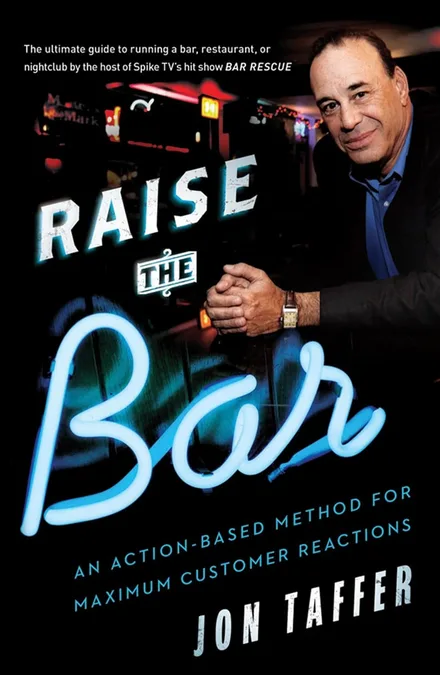
The source text
Raise the Bar — Jon Taffer’s own playbook
The doctrine on this page starts in Taffer’s 2013 book: reaction management, the owner-first diagnosis, menus and rooms engineered rather than decorated. If you run a bar — or just want the method without the television — this is the primary source.
Buying through this link may earn Bar Rescue Review a commission at no cost to you.
Jon Taffer calls his method a science. This page sets out the ten principles behind the rescues — each with the rule in his own sourced words (or labelled a paraphrase), why it works, the episodes that test it, and a checklist a working bar owner can apply this week.
“Running a bar is not just business, it’s a science. From the height of the stools to where your eyes fall first on a menu, no one knows more about bar science than Jon Taffer.”
— the show’s own opening narration, Bar RescueHow to read this page: direct quotes are used only where a checkable source prints them, and each is attributed where it appears. Everything else is labelled a paraphrase. And because this site tracks what happened to every rescued bar afterwards, each principle names the bars it was applied to with their current status — including the ones that closed anyway.
One thing not to copy: the shouting. In the framing of Raise the Bar itself, the raised voice is calculated for television’s compressed timetable, and the book is explicit that owners shouldn’t imitate it. Copy the system, not the volume.
Start here
Five principles carry the doctrine: one philosophy, one morality tale, one controversy, one delight, one tool.
Taffer’s process
Every rescue runs the same sequence — and the sequence, unlike the television timetable, transfers to a real bar:
The ten principles
Principle 1 of 10
The Owner Is the Ceiling
“Every failing business is a failing owner.”
Jon Taffer — interview, via 10minhotel’s Taffer playbook
“If I build them the Taj Mahal, they will destroy it if I don’t change them.”
Jon Taffer — interview, via 10minhotel’s Taffer playbook
Taffer fixes the person before the place, and starts every rescue with the owner — not the food, the music or the decor. The mechanism is simple: every chronic symptom in a bar — dust, overpours, untrained staff, deferred maintenance — is a behaviour the owner has seen and tolerated. Tolerated behaviour is the de facto standard, so new equipment or decor without a change in what the owner accepts buys a brief bump and a relapse. In management terms, the owner’s revealed preferences are the real operating system; everything else is apps.
ExtremesClosed
The only bar the show has ever rescued twice. The 2012 rescue worked — sales rose. The owner then spent the earnings on debts instead of maintenance, restored the bikini uniforms Taffer had replaced, and dropped Taffer’s menu.
Second Base Bar and GrillClosed
On the 2015 revisit, Taffer offered roughly $100,000 of help conditioned on the owner putting up about $30,000 of his own. The owner wouldn’t commit; Taffer walked away, and offered to help the staff find new jobs instead. The bar finally closed in February 2025.
Apply it this week
- Write down the five things you walk past daily that you’d criticise in someone else’s bar. Fix one per day.
- Set a maintenance and reinvestment line in the budget — even 2% of sales — and treat it as untouchable as rent.
- Stop drinking on shift and comping friends for a month; log every comp you would have given.
- Give your manager one decision this week that you do not override, even if you’d choose differently.
- Re-read last month’s reviews and name the pattern that is about you, not the staff.
Principle 2 of 10
Sell Reactions, Not Drinks
“He who causes the biggest reaction wins”
Jon Taffer — 2012 Nightclub & Bar Show keynote, via Bar & Restaurant
“We’re not in a logical business, we’re in an emotional business”
Jon Taffer — 2012 Nightclub & Bar Show keynote, via Bar & Restaurant
“The cook in the kitchen is not making a product. He’s making a vehicle. The vehicle drives the reaction.”
Jon Taffer — interview, via 10minhotel’s Taffer playbook
The product is not the drink or the food — it is the guest’s reaction to it. Chapter 1 of Raise the Bar is titled “You Sell One Thing: Reactions”, and the method is named Reaction Management — Taffer’s own framework, a proprietary doctrine rather than peer-reviewed science, and still his thesis in 2026: “Your product isn’t the food. It’s the reaction.” (keynote recap, FastCasual). Guests can’t evaluate your costs or intentions; they evaluate how the place made them feel at a handful of moments — arrival, first drink, first bite, a problem handled. Manage the stimuli and the reaction, and the spending, follows.
Racks Billiards and BourbonClosed
The series’ first rescue is also the worked case study in Raise the Bar’s opening chapter, where Taffer teaches Reaction Management. Honest framing: the principle outlived the bar — Angels, relaunched as Racks Billiards and Bourbon, closed in 2018. That is a point about execution and owners (Principle 1), not a refutation of the doctrine.
Apply it this week
- Stand at your own entrance at peak hour and watch faces for 15 minutes: arrival, first look around, first sip. Note the exact moments expressions change.
- Pick your one signature item and re-engineer its arrival — glassware, height, garnish, the server’s line — before touching its recipe.
- Brief staff: a reaction check two minutes after every first drink or food drop (“how’s that first taste?”) — and a recovery script when the answer is bad.
- Kill one thing that reliably produces a negative reaction — a smell, a sticky floor spot, a ten-minute no-greet — this week, rather than adding anything new.
- Managers on the floor during peak, not in the office — Taffer’s stated preference (FastCasual keynote recap).
Principle 3 of 10
Recon First: Judge Your Bar as a Guest
The rule (paraphrase of a sourced method): before changing anything, experience the bar exactly as a stranger does — anonymously, in sequence, from the street to the check. Taffer’s team measures the bar before intervention and again after, on the same criteria:
“If it can’t be measured, it can’t be improved”
The measure-before / measure-after method, as described on Taffer’s own site (jontaffer.com)
His book’s assessment likewise starts at the front door and audits cleanliness, signage, ambiance, design, lighting, music, staff demeanour, menu presentation and restrooms in order (per Shortform’s summary of Raise the Bar). The mechanism: owners develop blindness to their own room — they enter through the back, get greeted as the boss, and never queue, wait or pay. A structured guest-eye audit converts vague dread (“business is down”) into a located, fixable list, and creates the baseline that lets changes be judged rather than vibes-based.
The Baseline (AKA The Base Line)Open
Recon started outside: the exterior and signage were so uninviting that Taffer said he wouldn’t want to walk in, and his recon partner couldn’t tell it was a bar. Inside, the owner — who had never trained her staff — was put behind the bar herself and couldn’t execute 15 margaritas. Relaunched as The Baseline, the bar is still trading.
Apply it this week
- Recruit two people your staff don’t know. Give them a script: park, enter, order the signature drink and one food item, use the restroom, pay. Timed notes at each step.
- Score the walk from the street: can a passer-by tell what you are, that you’re open, and what you’re known for — in five seconds?
- Photograph ten things a guest sees in the first 60 seconds. Fix the worst three before buying anything.
- Repeat the same audit in 30 days with different spies, and compare scores line by line.
- Do the margarita test on yourself: make your five best-selling drinks to spec, timed, while someone watches. Any hesitation is a training gap, not a staff flaw.
Principle 4 of 10
Let the Market Decide the Concept — and the Name
“My crew gives me a demographic report that I’ve designed for about a four or five-mile ring, and a competitive report. If there are 10 sports bars, I won’t build a sports bar, obviously. So I know the competitors in the area, I know the demographics and psychographics of the marketplace.”
Jon Taffer — describing his own process, PvNew interview
The concept is chosen from data about the surrounding market, not from the owner’s fantasy — note the sourced figure is a four-to-five-mile ring. The name and identity then promise what that market wants. A bar’s realistic catchment is a few miles; the people inside that ring, and the competitors already serving them, bound what can work. An owner-identity concept (“I’ve always wanted a pirate bar”) optimises for an audience of one.
Corporate Bar and GrillClosed
The canonical case: a pirate theme bar, roughly $900,000 in debt, sitting in office-heavy Silver Spring, Maryland. Taffer’s demographic read said the ring wanted an after-work corporate crowd, so he rebuilt it as Corporate Bar & Grill. The owners rejected it, burned the new sign on YouTube, spent a reported $60,000 restoring the pirate theme — and closed in 2015.
The inverse of Piratz: naming tuned up to an affluent Boca Raton market — One11 became Boca Luna Luxe Lounge — and the bar is still trading.
That is Taffer’s doctrine. Our own tracked outcomes complicate it, and this page would be dishonest without them: of the 284 bars we track, the 213 Taffer renamed are still open at 40.4% (86 of 213), against 63.4% (45 of 71) for the bars that kept their names (χ² p = 0.0012).
The rename gap, in full → · Renamed bars in the survival explorer →
Apply it this week
- Pull a free demographic snapshot for a four-to-five-mile ring around your door (census / ACS data): age, income, households. Write one sentence: “The people actually around us are…”
- List every competitor in the ring by concept. If your concept duplicates the ring’s most common one, name your difference in one line — or admit there isn’t one.
- Ask ten regulars and ten strangers what they think your bar is. If the answers diverge wildly, your identity isn’t landing.
- Audit the promise chain: name → sign → first window → menu cover. Do they all promise the same thing to the same person?
- If you rename, rename toward the market, not toward your taste — and budget to change everything that carries the old name at once.
Principle 5 of 10
Layout Moves Money
The rule (his doctrine, paraphrased from sourced interviews): the room is engineered, not decorated. Taffer designs circulation so guests naturally pass, meet and linger — his signature device is the butt funnel, a deliberately narrowed pinch point where guests brush past each other and start conversations. He also designs to a uniform eye height, with seating and bar heights set so guests’ eyes sit at the same level and sightlines stay social. The topic is literally a segment of his 2026 Yahoo Finance interview — “The bar science: Eye heights, elevations and the butt funnel” — where he explains designing bars so every customer’s eyes sit at the same height. The origin, per Mashed’s reporting of his account: early in his career he watched a guest’s approach to another patron get exposed by a dead-end layout, and concluded that environment dictates behaviour.
Dwell time and social interaction are the two strongest levers on per-guest spend in a bar, and layout controls both: dead ends and blocked sightlines strand guests; pinch points create low-stakes contact; consistent eye levels make conversation across a room feel natural. That is environmental psychology applied to revenue — Taffer’s framing, labelled here as his doctrine, not peer-reviewed science.
Recon found a layout Taffer called one of the worst he had seen: no flow — and, per Reality TV Updates’ recap of the episode, not a single butt funnel, where he wants at least a double or triple. The relaunch as Boca Luna Luxe Lounge rebuilt the circulation; the bar remains open.
Apply it this week
- On your busiest night, sketch the room and trace ten guests’ paths. Mark every dead end, collision point, and spot where guests stand stranded holding a drink.
- Create one deliberate pinch point — a high table, a narrowed pass near the bar rail — where strangers naturally end up side by side.
- Check eye lines: sit on every seat type you own. If stools, booths and standing rails put faces at wildly different heights, adjust the worst offender.
- Clear the sightline from entrance to bar back — the back bar is your billboard; if a new guest can’t see it on entry, move what blocks it.
- Watch where staff bottleneck (service well, POS, glass return) and give service flow its own lane, separate from guest flow.
Principle 6 of 10
Measure the Pour — Then Measure the Sales
“If you’re waiting for a rise in your pour cost to alert you to a potential theft problem, you may be out of luck… While measuring your cost percentages is a pivotal thing to do, it’s not enough.”
Jon Taffer — Nightclub & Bar magazine, via The Free Library
Pour cost (the cost of liquor used, divided by liquor sales) must be measured — but it is not, by itself, an anti-theft system. Regardless of the scam, Taffer argues, the stolen proceeds wind up in the bartenders’ pockets, so theft shows up in sales: the companion metric is bar productivity, each bartender’s gross sales per hour, tracked shift by shift. A bartender consistently below the staff average is slow, underselling, driving guests away, or stealing — observation tells you which. His method points from the same article: calculate pour cost separately by category (liquor, beer, wine), audit frequently, and the owner takes the inventory — visible auditing is itself a deterrent.
Overpouring, giveaways and unrecorded sales are invisible in the moment and enormous in aggregate: small per-drink leakage, multiplied by hundreds of drinks a week. Percentages detect that money is missing; sales-per-hour data detects where. The pair converts a suspicion culture (“someone’s stealing”) into an auditable system — which is also fairer to honest staff.
The FederalOpen
Recon found bartenders who did not measure their pours at all, in a bar whose margins were already thin. Measured pours and built-to-spec signature drinks were core fixes; relaunched as The Federal, the bar is still trading.
Apply it this week
- Gauge every open bottle this week and compute pour cost by category — liquor, draft, bottled beer and wine separately. Write the number down; most failing owners have never seen theirs.
- Institute measured pours — jiggers, or measured free-pour counts — and spot-check with a pour test at shift start.
- Pull POS sales-per-hour per bartender for the last four weeks. Investigate outliers with observation, not accusation.
- Log comps, spills and staff drinks in the POS as their own keys — unlogged generosity is indistinguishable from theft in the numbers.
- Re-audit on a fixed cadence (weekly at volume, fortnightly otherwise) and investigate any swing of about two points in either direction — the trade article’s expert-panel guidance, offered as a rule of thumb, not a Taffer quote.
Principle 8 of 10
Clean Is the First Trust Signal
“One of the biggest [problems] is smell, cleanliness”
Jon Taffer — Mashed exclusive interview
“If I wipe my finger and that dust is there… I don’t focus on the fact that the dust is there. I focus on the fact that he let the dust be there.”
Jon Taffer — interview, via 10minhotel’s Taffer playbook
Taffer judges a bar within a few steps of the door, and the standard is about what the owner tolerates, not the dirt itself. Guests reason the same way he does: visible filth in the front is read as a promise of invisible filth in the kitchen. Cleanliness is the cheapest credibility a bar has and the fastest to lose — a signalling problem (guests can’t inspect your kitchen or your books, so they extrapolate from sticky floors, dusty bottles and bathroom state) and a standards problem (dirt accumulates at exactly the rate the owner tolerates).
Metal and LaceClosed
In Taffer’s own words to Mashed: “Probably the worst bar I’ve ever stepped into” — cockroaches walking across his wife’s foot, a Class 5 infestation, production shut down while the building was tented and fumigated, two inches deep in cockroaches. The owner’s response — “Well, there are bugs in Austin” — is quoted by Taffer as the real diagnosis. Headhunters closed in April 2014.
Recon spotted cockroaches in the kitchen; cooking was stopped on the spot and both bar and kitchen were shut down for an overnight deep clean before any redesign began. Relaunched as Natalie’s Bar and Grill, the bar is still open.
Apply it this week
- Do the finger test weekly, in writing: tops of bottles, speed rail, fan blades, bathroom fixtures, the line under the bar mat. Photograph the results.
- Build opening and closing checklists with named owners per task — “everyone’s job” is how a fryer gets jet-black.
- Clean one guest-visible thing guests can smell: lines, drains and mats are the usual sources. Draft lines go on a fixed two-week cleaning cycle.
- Put the bathrooms on an hourly check during service, signed off on a sheet on the door.
- When you find filth, ask Taffer’s question in the moment: who saw this and walked past? Fix that, not just the surface.
Principle 9 of 10
Hire the Personality, Teach the Skill
“Training is behavior modification. All we can do is teach the people we hire about our business.”
Jon Taffer — 2012 Nightclub & Bar Show keynote, via Bar & Restaurant
You cannot train attitude, so hire for it and teach the rest. His hiring method from the same keynote: the Eight Adjective Answer — write eight adjectives describing the person each open role needs, then hold conversations, not interviews, to find people who embody them. Raise the Bar makes the same argument (paraphrase, per book summaries): traditional hiring over-weights industry familiarity and under-weights the personality traits that drive customer reactions. And manage the people you have toward the standard — the keynote’s phrase is “manage for champions”. Drink specs and service steps are teachable in days; warmth, urgency, honesty and composure under load are traits, not curricula — and since the product is the guest’s reaction (Principle 2), the people producing reactions are the product’s main ingredient.
UNLV College of HospitalityOpen
The teaching doctrine with the volume up: hospitality students, not pros, brought to a working standard for a real event. Mixologist Brian Van Flandern’s target was each cocktail built in 45 seconds or less, and the recap notes his framing to the students: how you react to pressure is what defines you as a professional.
The corollary from the other side: the cook’s skill gaps were explicitly forgiven — he had not been trained and did not know better — but when confronted about the state of the kitchen he didn’t take it seriously, and was let go. Per the episode recap, Taffer’s stated condition is that he can fix and train, only if the person cares.
Apply it this week
- Before your next hire, write the eight adjectives for the role. If you can’t, you’re not ready to interview.
- Replace the interview with a conversation and a working trial: watch how the candidate treats the busser, not how they answer you.
- Write your drink specs and service steps down — “teaching” only works if there’s a document to teach from.
- Set one timed, observable standard per role — a signature cocktail built to spec in 45 seconds or less, at volume — and coach to it.
- When someone fails, diagnose trait vs. training honestly: re-teach the trained, exit the trait — quickly and kindly.
Principle 10 of 10
Stress-Test It Before You Trust It
The rule (sourced method, paraphrased): before the relaunch, flood the unreformed bar with a full house and watch what breaks. Per the training-industry analysis published on Taffer’s own site, the stress test exists to measure staff performance under load before any improvements, so the post-training reopening can be compared against a baseline — measurement first, verdicts second. On screen it is the moment systems, not intentions, are exposed: one-at-a-time drink building, tickets piling, stations collapsing — failures that are workflow failures, visible only at volume.
Most bar systems work fine at 30% capacity and fail at 90%: station layout, role clarity and composure are load-dependent properties. Testing under controlled load finds the breaking points while the cost of failure is one bad night, instead of every Friday forever. It is the hospitality version of a fire drill: you learn nothing from a system that was never pushed.
Shattered BarClosed
The stress test exposed a trained-on-paper team: bartenders made one drink at a time and couldn’t build the drinks they had just been taught to spec. The recap ties the collapse to an owner whose micromanagement and idea-shooting had already driven turnover and eroded the team’s confidence.
The Baseline (AKA The Base Line)Open
Its stress test descended into chaos about ten minutes in, with the bar team crowded around a single point — a station-design and role problem made visible, not a character verdict.
Apply it this week
- Run your own version quarterly: a friends-and-family or ticketed preview night at genuine full capacity, with you watching, not working.
- Instrument it: time from order to serve on ten drinks; count remakes, dumps and walk-aways. Write the numbers down.
- Classify every failure as station, system, stock or skill — fix in that order. Never start with “staff attitude”.
- Re-run after fixes and compare against the baseline numbers, Taffer-style.
- Set your collapse threshold in advance: the ticket time or queue length at which you add a body, open a second well, or 86 a menu item — decided calmly, not mid-meltdown.
Advice vs. outcomes
We track all 284 bars featured on the show; 131 of them are still open (46%). Getting the full Taffer treatment and surviving turn out to be different things — the advice on this page is his; the outcomes belong to the market, the owner and the lease. Where the two disagree — most sharply on renames, in Principle 4 — we print both, because a doctrine page that hides its own scoreboard isn’t worth trusting.
Sources & method: quotes and figures are drawn from Taffer’s interviews and keynotes (2012 Nightclub & Bar Show, Yahoo Finance 2026, PvNew), trade-press coverage (Nightclub & Bar magazine; Bar & Restaurant), the method write-ups on his own site, reporting by Mashed and FastCasual, and episode recaps from Reality TV Revisited and Reality TV Updates — each attributed where it appears. Famous rules that circulate without a checkable source are not printed here as his. Bar statuses are our own tracking, compiled October 2026; how they are verified is set out on the About page.